
CERN Management for 2026-2030

This document sets out CERN’s top-level governance and management structures and the related responsibilities for the period 2026–2030. The aim is to provide clarity on:
- CERN’s governance and management;
- the remits, roles and responsibilities of CERN’s sectors and departments, as well as the Office of the CIO;
- the functioning of the main executive and cross-organisational management teams; and
- CERN’s overarching principles, values and culture.

A PDF version is available on CDS.
The practices and procedures of the CERN Council and its subordinate bodies are summarised below.
1.1 CERN Status and Convention
CERN is an intergovernmental organisation established by treaty, the CERN Convention, which was signed in 1953 and entered into force in 1954. It was amended in 1971.
The Convention defines the Organization’s purpose as providing for collaboration among States in nuclear research of a purely scientific and fundamental character, and in research essentially related thereto, through the construction and operation of shared research facilities and the promotion of international scientific cooperation.
Notably, it stipulates that the Organization’s scientific results shall be made publicly available and that it shall have no concern with work for military requirements.
The Convention establishes CERN’s programme of activities, bodies, governance and membership, as well as a formula for the financial contributions of its Member States. It is complemented by a Financial Protocol, agreements with CERN’s Host States, agreements with its Member and Associate Member States and a protocol on privileges and immunities.
The Organization’s governance is founded on the participation of its Member States, which collectively fund the Organization, are represented on the CERN Council and exercise full decision-making authority through voting rights.
The Associate Member States have attendance rights in the Council and some of its subordinate bodies but do not have voting rights, reflecting their more limited role in the governance of the Organization.
Furthermore, CERN grants Observer status to certain States and intergovernmental organisations that maintain close scientific or institutional links with the Organization. Observers may attend specific Council agenda items but do not participate in formal decision making, enabling CERN to maintain strong international partnerships while keeping governance authority within its membership framework.
Together, CERN’s Member States, Associate Member States, and Observer States and Organisations contribute to a robust framework that combines governance, international participation and global scientific collaboration. This framework, founded in the CERN Convention and related legal instruments, respects CERN’s international legal personality and enables it to act independently in pursuit of its mission and in the best interests of the Organization.
1.2 CERN Council
1.2.1 Role of the Council
The Council is the supreme decision-making authority of the Organization. It determines the Organization’s policy in scientific, technical and administrative matters, defines its strategic programmes, sets and follows up its annual goals and approves its budget.
The Council is composed of two delegates from each Member State, typically:
- one representing the state’s national government/administration;
- one representing the state’s national scientific community.
No employed member of the CERN personnel, and no associated member of the personnel in receipt of financial benefits from the Organization, may represent a Member State in the Council.
The Council follows defined Rules of Procedure and is chaired by the President of Council. The Director-General of CERN is the Secretary of the Council, ensuring that the Council has the infrastructure it requires, as well as the necessary support, including from a dedicated Council secretariat and the CERN Legal Counsel.
The Council typically holds four ordinary meetings (known as “Sessions”) each year, although it can hold more. It also has the possibility of holding extraordinary Sessions at the request of either the President or at least five Member States.
The Council has three operating modes: Open, Restricted and Closed. Different attendance rights apply to each. The Open Council is held in public. The Council normally meets in person; however, in exceptional circumstances, the President may decide to conduct a meeting on a hybrid or remote basis. The Council is assisted in its functions by five subordinate bodies: the Finance Committee, the Scientific Policy Committee, the Tripartite Employment Conditions Forum, the Audit Committee and the Pension Fund Governing Board, further explained in paragraph 1.3 below.
1.2.2 Role of the President of Council
The President of Council is elected by the Council and holds office for one year, with the possibility to be re-elected on not more than two consecutive occasions.
Normally, the President is elected from among the Council delegates, although, for the duration of the term of office as such, the President is not a delegate.
The President prepares the agendas and chairs the Sessions of the Council and participates in the proceedings in an impartial way and not in the interest of any Member State. In the exercise of the President’s functions, the President is under the sole authority of the Council.The President is supported in these functions by two Vice-Presidents, who are elected by the Council.
1.3 Subordinate Bodies of the Council
The five subordinate bodies of the Council are the:
1.3.1 Finance Committee (FC)
The FC monitors the overall financial situation of the Organization and provides recommendations to the Council on financial, planning, budgetary, procedural, personnel and commercial matters, including the adjudication of CERN’s procurement and service contracts. The general remit, detailed responsibilities, composition and working procedures of the FC are set out in the Terms of Reference, which entered into force on 1 October 2022.
Each CERN Member State can send up to two representatives (known as ‘members’) and up to two advisers to attend the FC. Associate Member States are also entitled to send representatives to the FC, who can take the floor but cannot vote.
The Committee meets at least once prior to each ordinary Council Session and can hold additional meetings. Meetings in ‘normal’ operating mode are also attended by the CERN Directors, Department Heads and representatives of the CERN Staff Association.
Each June, the FC reviews the previous year’s Annual Progress Report, as well as the Financial Statements of both CERN and the Pension Fund, and recommends their approval to the Council. It also reviews the Medium-Term Plan (MTP), which includes the Budget for the following year. In the second half of the year, it advises the Council on matters such as the cost-variation index and the site and buildings consolidation plan.
For personnel issues, the FC benefits from the advice of the Tripartite Employment Conditions Forum (TREF), as described below in Section 1.3.3.
1 The MTP is CERN’s core planning and budgeting document covering a multi‑year horizon (typically 5 years). It sets out: scientific programme priorities; major projects and upgrades; resource requirements (financial + workforce); and strategic objectives across sectors.
1.3.2 Scientific Policy Committee (SPC)
The SPC monitors the overall scientific activities of the Organization, including through periodic horizon scanning, and provides input and recommendations, in particular on:
- the priorities of research programmes and the allocation of research efforts, both within the laboratories of the Organization and extramurally;
- the scientific aspects of the European Strategy for Particle Physics;
- the Medium-Term Plan (MTP);
- the achievements of the Organization against the annual goals set for the previous year;
- senior staff appointments to be made by the Council;
- the management and staffing of the Organization, from the point of view of scientific policy, including the programmes concerning Graduates and associated members of the personnel; and
- any other scientific and technical matters that affect the activities of the Organization.
The general remit, detailed responsibilities, composition and working procedures of the SPC are outlined in the Terms of Reference, which entered into force on 1 November 2023.
There are two categories of member in the SPC: Council-appointed members and ex officio members:
- Council-appointed members act ad personam and do not represent the interests of any state or constituency. Their term of office is a single, fixed period of four years.
- Ex officio members are the Chairs of other scientific bodies established at CERN, such as the LHC Experiments Committee (LHCC), the SPS Experiments Committee (SPSC), and the Isolde/Neutron Time-of-Flight Experiments Committee (INTC). They similarly act ad personam and, while they can report on the activities of their respective bodies, they do not represent the interests of any state or constituency in the decision-making process of the Committee.
The Committee meets at least once prior to each ordinary Council Session and may convene additional meetings at the request of the Council, the Chair or the majority of its members.
1 The MTP is CERN’s core planning and budgeting document covering a multi‑year horizon (typically five years). It sets out: scientific programme priorities, major projects and upgrades, resource requirements (financial and workforce), and strategic objectives across sectors.
1.3.3 Tripartite Employment Conditions Forum (TREF)
Established in 1994, TREF is a tripartite forum that discusses the general working conditions at CERN, as well as diversity and inclusion and the Organization’s annual personnel statistics. It advises the Council, normally through the FC, on, inter alia, aspects of CERN remuneration and employment conditions, including associated modification to the Staff Rules and Regulations. Through its activities, TREF plays a valuable role in giving the Member States, the Management and the Staff Association an opportunity to express their views and thereby facilitates smooth decision taking by the FC and the Council.
TREF comprises representatives of the Member States, the Management and the Staff Association. Its general remit, detailed responsibilities, composition and working procedures are set out in the Terms of Reference, which entered into force on 1 April 2023.
TREF typically holds ordinary meetings twice per year, except in years in which the Organization’s five-yearly general review of the financial and social conditions is under way, when it meets more often.
The TREF Chair reports to the FC at each meeting where a proposal that has been discussed at TREF is being submitted to the Council for feedback or decision. The TREF Chair also presents an annual TREF activity report to the Council.
1.3.4 Audit Committee (AC)
The AC provides independent, objective advice and guidance on the adequacy and effectiveness of the Organization’s arrangements in the following areas:
- governance structure;
- risk management;
- values and ethics;
- internal control framework; and
- oversight of internal and external audit.
Through its analysis of audit reports and its interactions with the External Auditors and the CERN Internal Audit Service, supplemented by regular interactions with the management representatives of CERN and the Pension Fund, the Committee provides assurance to the Council on the adequacy of the audit arrangements within the Organization.
The Committee’s general remit, detailed responsibilities, composition and working procedures are set out in the Terms of Reference, which entered into force on 1 July 2023.
The AC comprises at least two members appointed by the Council from among Council delegates and Finance Committee members (of whom at least one must be a Council delegate), including the Chair, and up to four external expert members with in-depth experience in audit matters. The President of the Council and the Chair of the FC attend the meetings of the AC in an ex-officio capacity.
The AC meets at least four times a year, normally in advance of the meetings of the Council. The AC Chair reports to the FC and Council at every Session on the progress of the Committee’s work and presents an annual activity report for the year.
1.3.5 Pension Fund Governing Board (PFGB)
As an intergovernmental organisation, CERN must provide its employed members of the personnel with insurance against, inter alia, the economic consequences of disability, old age and death. It does this through “the CERN Pension Fund”, in accordance with the Rules and Regulations of the Fund.
The Fund is an integral part of CERN, has no separate legal personality and lies under the supreme authority of the Council. The Fund is managed by its Chief Executive Officer. Its activities form part of the official activities of the Organization.
The PFGB is entrusted by the Council to carry out oversight of the Pension Fund, assisted and advised by an Investment Committee and an Actuarial and Technical Committee.
1.4 Authority Delegated to the Director-General
Article VI of the CERN Convention states that the Council appoints the Director-General, who is the chief executive officer of the Organization and its legal representative. Each Director-General is assisted by such scientific, technical and administrative staff as is considered necessary and authorised by the Council.
The structure and procedures of CERN’s executive management are summarised below.
2.1 Authority of the Director-General
The Director-General delivers the overall management of CERN under delegated authority from the Council. Appointed by the Council to be the Organization’s chief executive officer, the Director-General’s responsibility includes the implementation of CERN’s strategic direction, programmes and annual objectives, as approved by the Council, as well as the efficient use of the Organization’s resources. Under current procedural rules, the Director-General is appointed for a single fixed five-year term.
The Director-General is supported in the discharge of executive management responsibilities by the Directorate. The Director-General proposes the structure of the Directorate and Department Heads and nominates specific candidates for these positions for appointment by the Council. The Council typically approves these appointments for the duration of the mandate of the Director-General.
Acting under the authority of the Director-General:
- Directors have managerial authority over their Sector’s departments and ensure the effective organisation, coherence and performance of these departments’ activities;
- Directors also ensure appropriate risk management, resource stewardship and cross‑sector coordination in the execution of their Sector’s mandate;
- Each Department Head reports to a Director. The Department Heads lead the activities and the financial, human and material resources of their specific department.
In this framework, management authority flows from the Council to the Director-General, through the Directorate and Department Heads, to the wider Organization.
2.2 Director-General’s Safety Responsibilities
As the person with ultimate responsibility for matters of Safety at CERN, the Director-General has defined responsibilities and implements an organisational safety structure according to CERN Safety Regulation SR-SO. Safety at CERN covers occupational health and safety, including radiation protection, the protection of the environment and the safe operation of CERN’s installations, including radiation safety.
2.3 Non-responsibility for Management of the Experiments
The Director-General is not responsible for the internal management of the multinational scientific collaborations that constitute the experiments hosted at CERN. Responsibility for their management sits with each experiment’s own internal structure.
3.1 Overview
The top-level of the CERN management structure is comprised of three layers:
- The Director-General.
- The Directorate; for the 2026-2030 mandate, the Directorate functions as CERN’s senior leadership team and is made up of:
- the Director-General
- the Directors of CERN’s five sectors:
- Director for Accelerators and Technology;
- Director for Research and Computing;
- Director for Stakeholder Relations;
- Director for Finance and Human Resources;
- Director for Site Operations;
- the Chief Information Officer.
- The Senior Management Team; this body comprises the members of the Directorate and the Department Heads of each of CERN’s thirteen departments.
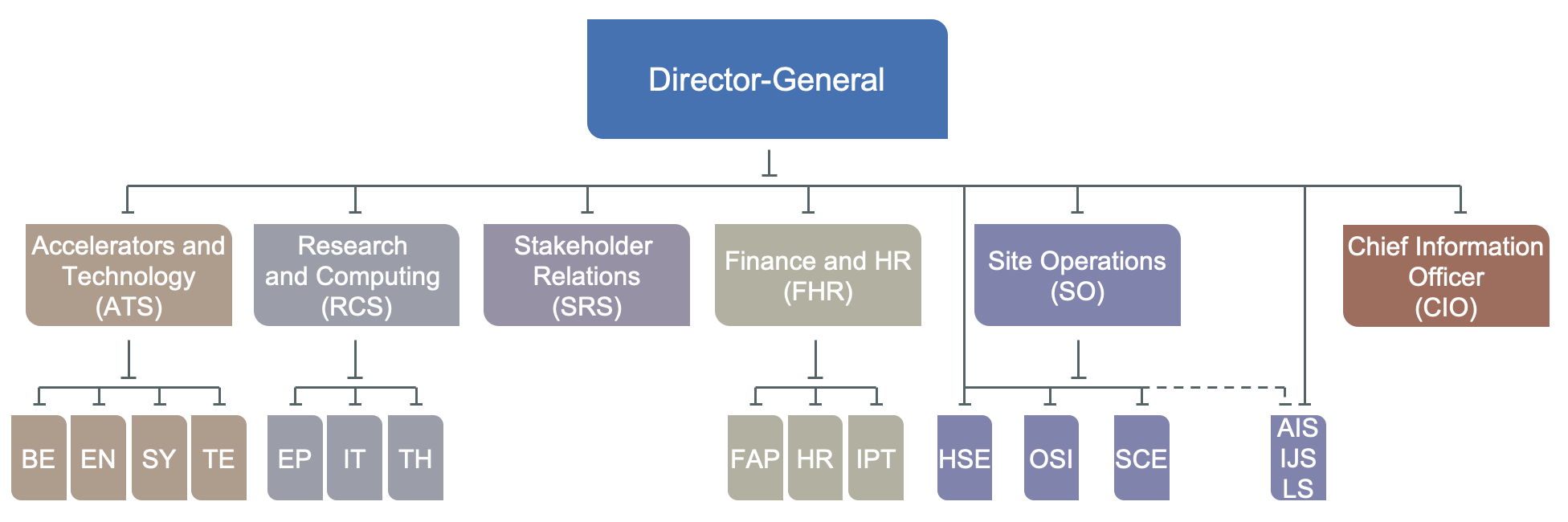
3.2 Directorate Roles and Responsibilities
3.2.1 Director-General

The Director-General manages the CERN Laboratory, prepares proposals for decision by the Council, implements Council decisions and reports to the Council on the execution of CERN’s scientific, technical and administrative programme. The Director-General can also propose any adjustment deemed necessary to meet the evolving needs of the Organization’s research programme. The Director-General leads the Directorate and chairs the Executive Board.
In the 2026-2030 mandate, the following functions report directly to the Director-General:
- the Directors;
- the CIO;
- the FCC Project Leader;
- the Legal Counsel;
- the Head of the Internal Audit and Investigation Services;
- the Head of the Internal Justice Secretariat;
- the Head of the Health, Safety and Environmental Protection Department;
- the Ombud; and
- the Head of the Director-General’s Office.
3.2.2 Director for Accelerators and Technology (ATS)

The Director for Accelerators and Technology is responsible for the strategic leadership and overall coordination of CERN’s accelerator and accelerator‑technology activities, ensuring their alignment with the Organization’s scientific objectives and long‑term plans. The role includes responsibility for the oversight of major programmes and projects within the sector, including the operation, consolidation and upgrade of the CERN accelerator complex and engineering support for the experiments.
Acting within the collective framework of the Directorate, the ATS Director contributes to CERN‑wide policy formulation and decision‑making while ensuring the sustainable delivery of the Organization’s core accelerator infrastructure.
3.2.3 Director for Research and Computing (RCS)

The Director for Research and Computing is responsible for the high-level oversight of the experimental and theoretical research activities of the Laboratory, including scientific computing, to ensure that the Sector’s strategy, priorities and predefined scope of activities are respected.
The RCS Director holds regular meetings with the managements of the Sector’s departments and of the experiments, to discuss their overall status, including budget, personnel and project management. The Sector hosts thousands of scientific users attached to the experiments (Users) and visiting scientists (the majority of whom are theoretical physicists).
The RCS Director is an ex officio member of the CERN scientific committees and is responsible for appointing the chairs and members of these committees. The RCS Director chairs the Resource Review Boards and the Finance Review Committees, which ensure regular scrutiny of the experiments’ finances. The RCS Director also represents the Organization in various European and International high-level scientific committees.
3.2.4 Director for Stakeholder Relations (SRS)

The Director for Stakeholder Relations is responsible for leading and guiding CERN’s strategic engagement with the Member and Associate Member States, the Host State authorities, the European Union, international organisations, partners, and broader societal stakeholders, in order to secure sustained political, financial and public support for the Organization’s scientific mission.
The SR Director develops and implements CERN’s stakeholder relations strategy, governance frameworks and engagement policies, ensuring alignment with institutional objectives and international obligations. Through leadership of the SR Sector, the SR Director provides strategic oversight of CERN’s international relations, partnerships, communications, outreach, education and protocol activities.
The SR Director represents CERN in high-level bilateral and multilateral fora, strengthens global cooperation and geographical enlargement and fosters strategic partnerships that enhance CERN’s impact in science, innovation and education. The SR Director further ensures that stakeholder insights are integrated into organisational decision making to reinforce CERN’s role as a leading model of international scientific collaboration.
3.2.5 Director for Finance and Human Resources (FHR)

The Director for Finance and Human Resources is responsible for the strategic leadership and overall coordination of CERN’s financial management, human resources policy, procurement, knowledge transfer, business computing and the related administrative functions, in support of the Organization’s scientific objectives.
The FHR Director also provides expert guidance to the Director‑General and senior management on all matters related to these domains and ensures that the Organization’s resources are aligned with its scientific and operational objectives.
Finally, the FHR Director maintains relationships with numerous internal and external stakeholders. These include the FC and the Council, the External Auditors, the Staff Association and senior figures from financial institutions acting as a key interface between CERN and its governance and oversight bodies.
3.2.6 Director for Site Operations (SO)

The Director for Site Operations ensures the coherent, efficient and reliable delivery of CERN’s day‑to‑day non‑scientific and non‑accelerator operations. By bringing together diverse operational functions under the site operations umbrella, the Sector strengthens coordination, drives continuous improvement and supports the Organisation’s overall performance and sustainability.
The SO Director effectively acts as CERN’s Chief Operating Officer, with a cross‑cutting mandate providing strategic oversight and integration across key operational domains, including site operation and development, health, safety and environmental protection, corporate sustainability, organisational resilience and continuous improvement. Together, these areas of activity ensure that CERN’s infrastructure and services fully support its scientific mission.
From an administrative perspective, the heads of Health, Safety and Environmental Protection (HSE), the Legal Service, the Internal Audit and Investigations Services and the Administration of Justice Secretariat are attached to the Site Operations Sector but retain functional independence and continue to report directly to the Director‑General.
3.2.7 Chief Information Officer (CIO)

The CIO heads the Office of the Chief Information Officer (OCIO) and is responsible for overseeing and guiding the Organization’s digital technology strategy, governance and policy across all sectors. This includes developing and implementing policies, ensuring compliance with international regulations and driving digital transformation initiatives.
The OCIO comprises a team of senior CERN experts dedicated to strategy development, governance and policies, while implementation and delivery is distributed across CERN’s departmental structure. In this way, the CIO leads the integration of relevant technologies at CERN, including AI, HPC, quantum computing and others, ensuring safe adoption and alignment with organisational goals.
The CIO also represents the Organization in various European and International high-level digital information technology and strategy committees and initiatives.
4.1 Function
The Executive Board (EB) is the senior executive management body of the Organization. It provides a forum for collective discussion, decision making and advice on matters of strategic, organisational, financial and operational significance that cut across sectors or require Organization‑wide coordination.
The EB’s purpose is to support the Director‑General in the collective leadership, strategic coordination and executive oversight of CERN, ensuring coherence across sectors and alignment with the Organization’s mission, long‑term strategy and governance framework.
Where appropriate, EB discussions and decisions contribute to the preparation of documents, proposals and recommendations submitted to the Council.
Within the authority of the Director‑General and any directions given by the CERN Council, the EB addresses in particular:
- Organization‑wide strategy and priorities;
- cross‑sector coordination and trade‑offs;
- major organisational, resource and risk‑related issues;
- preparation for and implementation of Council decisions;
- issues escalated by members of the Directorate where collective executive consideration is required.
The EB operates within CERN’s established governance framework and supports, but does not replace, the statutory authority of the CERN Council, nor the line management responsibilities of the Director‑General or the Directors within their respective sectors.
4.2 Composition
The EB is composed of the Director‑General, the Directors and the CIO, each participating ex officio by virtue of their functions.
Absent EB members can be represented by an alternate on an ad hoc meeting-specific basis and only with the exceptional agreement of the Director‑General.
Experts in a specific subject matter may be invited to make a presentation to the EB where the EB Chair considers it merited in respect of one or more topics on the agenda.
4.3 Meetings
The EB convenes in person every month for a half‑day meeting, typically 7–10 days following the prior Management Board meeting. Meetings are convened and chaired by the Director‑General or, in the exceptional case of the Director‑General’s absence, by a member of the Directorate designated by the Director-General for such purposes.
A secretariat function is provided by the Director‑General’s Office, which is responsible for organising EB meetings, coordinating agendas, providing documentation, minuting EB discussions and performing any administrative follow‑up.
The agenda for each meeting is prepared by the Director‑General in close consultation with the members of the EB, with each individual agenda item proposed and sponsored by at least one member of the Directorate.
Agenda items are presented using a standardised template, ensuring a consistent structure for analysis and decision making, including:
- a summary;
- the issues to be addressed;
- risks;
- resource implications.
4.4 Overview of Scientific and Operational Bodies Reporting to the Executive
The High-luminosity Machine Committee (HLMC) is the executive committee for the technical and performance aspects of the LHC machine for the high-luminosity era. It brings together activities previously managed by the LHC Machine Committee (LMC) and the Technical Coordination Committee of the High Luminosity LHC upgrade project (HL-LHC TCC). The committee’s mandate extends throughout LS3 and the subsequent recommissioning phase. It defines, maintains, and evolves the LHC operational baseline covering the machine parameters, operational configurations and the associated hardware layout and options.
The HL-LHC Project Leader and the Long Shutdown 3 Coordinator report to the EB in respect of each of these strategic CERN activities. Other major transversal projects integrated into the LS3 coordination structure during the 2026–2030 mandate will also be regularly reported on in the EB. These include the SPS North Area Consolidation project, the ECN3 Beam Dump facility, SHiP preparation, the Physics Beyond Collider (PBC) studies and the newly created development of a Non-Collider Physics Implementation Roadmap for CERN.
The CERN experiments are reviewed by scientific committees that include external experts: the Detector Research and Development Committee (DRDC), the ISOLDE and Neutron Time-of-Flight Experiments Committee (INTC), the LHC Experiments Committee (LHCC), the Recognised Experiments Committee (REC) and the SPS and PS Experiments Committee (SPSC).
The above-mentioned scientific committees make recommendations to the Research Board (RB
), which then decides on the experimental programme of the Laboratory. The RB is chaired by the Director-General, with several Directors and Department Heads and also the chairs of the scientific committees as members. Financial aspects are overseen by Resources Review Boards for the large LHC experiments and the WLCG, and by financial review committees for the other experiments. More information can be found at: https://committees.web.cern.ch/.
The Advisory Committee of CERN Users (ACCU) is a forum for the exchange of information and discussion between the CERN Management, ex-officio members and the appointed representatives of CERN’s User community to review the practical means taken by CERN to support the work of Users at the Laboratory.
While not directly reporting to the Executive, various FHR committees and bodies provide substantial input as a basis for decision-making by the EB in the domains of finance and human resources.
The Site Operations Board (SOpB), chaired by the SO Director and attended at Head of Department level from all Sectors, ensures that CERN’s site operations remain aligned, efficient and fit to support CERN’s long-term scientific programme. The SOpB oversees site operational challenges cutting across departmental boundaries, such as site development and space use, sustainability, resilience, scientific information and site operational performance.
As defined in CERN’s Safety Regulations (SR-SO), the Safety Policy Committee (SAPOCO) is an advisory body to the Director-General on matters related to the CERN Safety Policy. It advises on the definition of the CERN Safety Policy and on appropriate measures for its implementation. It contributes to the establishment and revision of the CERN Safety Rules, as specified in the relevant procedures.
The CIO Community for Collaboration and Coordination (C4) is the governance framework through which the Office of the CIO coordinates and oversees CERN’s digital and ICT agenda. It brings together members of the Office of the CIO and representatives from across the Organization through a network of specialised technical and programme committees covering areas such as architecture, cybersecurity, artificial intelligence, data management and other cross-cutting digital topics. These committees provide advice, recommendations and monitoring within their respective remits, while the C4 Steering Committee, chaired by the CIO and attended at Head of Department level, provides strategic direction, oversight, prioritisation and decision-making across CERN’s digital and ICT landscape.
The C4 receives input from specialised technical and programme committees, such as the AI Programme Committee (AIPC), which is the principal cross-organisational body for the coordination, prioritisation and implementation oversight of CERN’s AI programme, and the Open Science Steering Board (OSSB), which provides strategic oversight for CERN’s Open Science programme, ensuring alignment with the Organization’s commitments to open access, FAIR data and open source software. The OSSB also coordinates CERN’s positioning in international open science initiatives.
The CERN Medical Applications Steering Committee (CMASC) selects, prioritises, approves and coordinates all proposed medical applications-related projects. The Committee receives input from the Medical Applications Project Forum (MAPF) and various KT bodies.
To ensure effective coordination across CERN, dedicated FCC coordinating boards have been established between CERN sectors and the FCC Project Office with a focus on the FCC-ee during the Reference Design Phase:
- FCC-ATS Machines and Infrastructures Committee (FMIC);
- FCC Civil and Environmental Coordination Board (FCECB);
- FCC Stakeholder Relations Coordination Board (FSCB); and
- FCC Research and Computing Board (FRCB).
Within their respective domains, these boards support the efficient and coherent execution of the programme defined by the FCC Project Leader. The Chairs of these boards report to the EB at least once per year.
The Tripartite Committee for the Territorial Implementation of the FCC coordinates activities between the authorities of the Host States, the CERN Management and the FCC Project Office.
The Science Gateway Steering Committee is co-chaired by the Directors of SO and SR. It coordinates the operation of the Science Gateway campus and the production of content and activities for the same.
The Heritage Committee oversees CERN’s activities in terms of the preservation and management of its archives and historically relevant scientific equipment and oversees the efforts to document CERN’s history.
5.1 Function
The Management Board (MB) supports the Director‑General and the Directorate by ensuring effective coordination, alignment and preparation of management matters prior to their submission to the EB.
The MB enables structured cross‑sector dialogue and coordination and refinement of proposals, contributing to the efficient functioning of CERN’s executive governance. It supports the coordination and preparation of matters to be submitted to the EB, as well as ensuring alignment across sectors on operational and strategic issues.
Issues considered by the MB typically include:
- cross‑sector operational matters;
- organisational and resource‑related topics requiring coordination;
- preparatory discussion of proposals intended for EB decision.
MB meetings are scheduled in advance of EB meetings, typically at an interval of approximately one week to allow the preparation, consolidation and refinement of items prior to EB discussion and decision.
While the MB may formulate recommendations and identify preferred options, it is not a decision‑making body. Formal management decisions, informed by MB discussions, are taken at the level of the EB. The MB does not replace line‑management responsibilities and does not address matters that can be effectively resolved within individual sectors or departments.
5.2 Composition
The MB is composed of the Directorate and the Department Heads.
Absent MB members can be represented by an alternate on an ad hoc, meeting-specific basis, provided that this is announced in advance to the Director-General’s Office.
Experts in specific subject matter may be invited to make a presentation to the MB where the MB Chair considers it merited in respect of one or more topics on the agenda.
5.3 Meetings
The MB convenes in person every month. Its meetings are convened and chaired by the Director‑General or, in the Director‑General’s absence, by a member of the Directorate designated by the Director-General for such purposes.
A secretariat function is provided by the Director‑General’s Office, which is responsible for organising MB meetings, coordinating agendas, providing documentation, minuting MB discussions and performing any administrative follow‑up. Each MB meeting agenda is proposed by the Directorate and prepared in consultation with each Director’s respective departmental leadership team (i.e. their Department Heads).
Agenda items must individually have a sponsor from among the Directorate before they are accepted for inclusion. Agenda items are structured using a standardised template to ensure clarity, consistency and completeness of information, including:
- a summary;
- the issues to be addressed;
- risks;
- resource implications.
The MB produces coordinated views, recommendations and refined proposals to support subsequent EB deliberations. Following each MB meeting, draft minutes and action items are circulated to the MB members within three working days. Ownership of follow‑up actions rests with the relevant Directors or Department Heads, as appropriate.
The highlights of MB decisions are communicated to the CERN community on a regular basis.
6.1 Accelerators and Technology
ATS is responsible for the safe, reliable and efficient operation of CERN’s accelerator chain, including the Large Hadron Collider (LHC) and its injector complex. It oversees the full lifecycle of accelerator systems and the associated technologies in direct support of CERN’s scientific mission.
Scope of Activities
ATS designs, develops, operates, maintains and evolves CERN’s accelerators and the specialised technologies that underpin them. Its areas of specialisation include magnets, radiofrequency systems, beam instrumentation, cryogenics, power and ventilation systems and control infrastructure. These are typically developed in-house due to their unique requirements. ATS also supports the use of these technologies in the experiments.
A central priority of ATS is the upgrade and long‑term evolution of CERN’s accelerator infrastructure, notably through flagship programmes such as the High‑Luminosity LHC (HL‑LHC), ensuring CERN’s continued scientific leadership in accelerator technologies.
Organisation and Structure
ATS is structured into four departments (as shown in Figure 2): Beams (BE), Engineering (EN), Accelerator Systems (SY), and Technology (TE). The structure is designed to ensure coherence between the disciplines of accelerator physics, engineering, system integration and applied technologies.
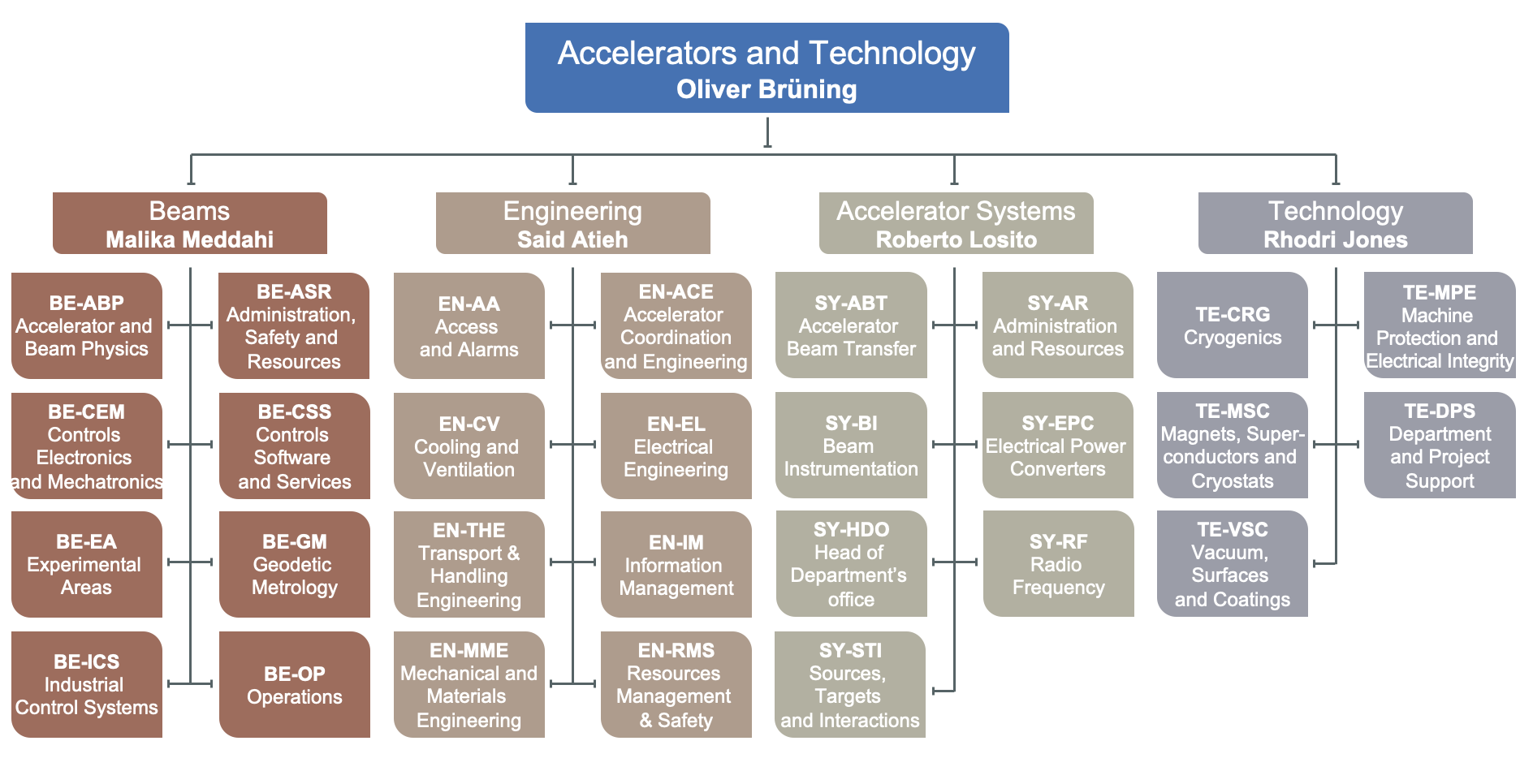
6.1.1 Beams Department (BE)
BE is responsible for the conception, design, survey, alignment, control and operation of all of CERN’s accelerators, technical infrastructure, accelerator test facilities, secondary beam lines and experimental areas. Its mission for the period 2026–2030 is to empower CERN’s future by achieving operational excellence in beam accelerator operations, through the continued modernisation of the accelerator complex and the development of the advanced tools required to meet future challenges. The emphasis during this period will be on the execution of the BE’s contributions to LS3 in fulfilling the above mission.
Scope of Activities
BE leads the operation of CERN’s accelerators, including the LHC, the injector chain and the associated facilities. It ensures optimal performance in terms of intensity, stability, brightness and beam availability, supported by advanced control systems enabling safe and reproducible operations.
Expertise and Contribution
BE maintains world-class expertise and state-of-the-art knowledge in the specialised fields associated with accelerator physics, including particle beam dynamics, particle simulation codes, novel acceleration techniques, precise timing, robotics, mechatronics and geodetic metrology. The Department conducts and collaborates in pioneering research and development to continuously improve the CERN accelerator and experimental-area complexes and to meet the requirements of future upgrades and projects.
6.1.2 Engineering Department (EN)
EN is CERN’s central engineering authority. It provides the competences, infrastructure systems and technical coordination required for the design, installation, operation, maintenance and dismantling phases of the CERN accelerator complex and its experimental facilities.
Scope of Activities
EN operates, maintains and consolidates CERN’s infrastructure, such as its electrical distribution, cooling and ventilation, transport, handling, access and alarm systems. These systems underpin the safe and reliable operation of both the accelerators and the experiments hosted on-site.
Expertise and Contribution
EN provides mechanical engineering and materials expertise for the design, prototyping, manufacturing and assembly of accelerator and detector components. The Department is also responsible for technical coordination during CERN’s technical stops, and the shutdowns in the accelerators and experiments, ensuring that interventions across departments are planned and executed safely, coherently and efficiently.
6.1.3 Accelerator Systems Department (SY)
Departmental overview
SY is responsible for delivering efficient beam-related technical systems for CERN’s accelerators.
Scope of Activities
SY designs, constructs, operates and decommissions accelerator systems. It serves as CERN’s technical authority on normal and superconducting radio frequency systems, beam instrumentation, beam intercepting devices, beam injection, extraction and transfer facilities and power conversion systems. It further trains and develops the next generation of physicists, engineers and technicians in these domains.
Expertise and Contribution
SY maintains world-class expertise and state-of-the-art knowledge in accelerator systems and the associated specialised technological fields, such as radio-frequency engineering, acceleration techniques, electromagnetic and photonic sensor technology, beam-matter interaction, pulsed magnet technology and precise current generation and measurement.
6.1.4 Technology Department (TE)
Departmental overview
TE is responsible for the accelerator‑specific technologies and technical systems required for the operation, upgrade and future development of CERN’s particle accelerators.
Scope of Activities
The Department’s focus is on developing, operating and maintaining core accelerator technologies: superconducting and normal-conducting magnets, magnet and circuit protection systems, cryogenic installations and ultra-high vacuum systems. TE also supports cryogenic and vacuum systems for the experiments.
Expertise and Contribution
TE maintains world-class expertise in specialised technological fields such as low and high-temperature superconducting technology, machine protection, electrical quality assurance techniques, cryogenic and vacuum technology, and coating and surface treatment techniques. The Department performs the research and development in these areas required for the consolidation and upgrade of the existing CERN accelerator complex and for future CERN projects, in full collaboration with European partners and international collaborators.
6.2 Research and Computing (RCS)
RCS is responsible for all aspects of CERN’s experimental and theoretical scientific research, including the LHC and non-LHC programmes, and for the computing infrastructure required to support it.
Scope of Activities
The activities within RCS include participation in and provision of support to CERN-based experiments and other approved projects, research in theoretical physics, detector R&D and the development and operation of the computing infrastructure and services. In the period 2026–2030, RCS’s highest priority is to complete the Phase 2 upgrades of the ATLAS and CMS detectors, to be ready for the start of High-Luminosity LHC operation.
Organisation and Structure
RCS is organised into three departments: Experimental Physics, Theoretical Physics and Information Technology (as shown in Figure 3). It also comprises a group for projects, which is overseen directly by the RCS Director. At present, the only project is the Neutrino Platform.
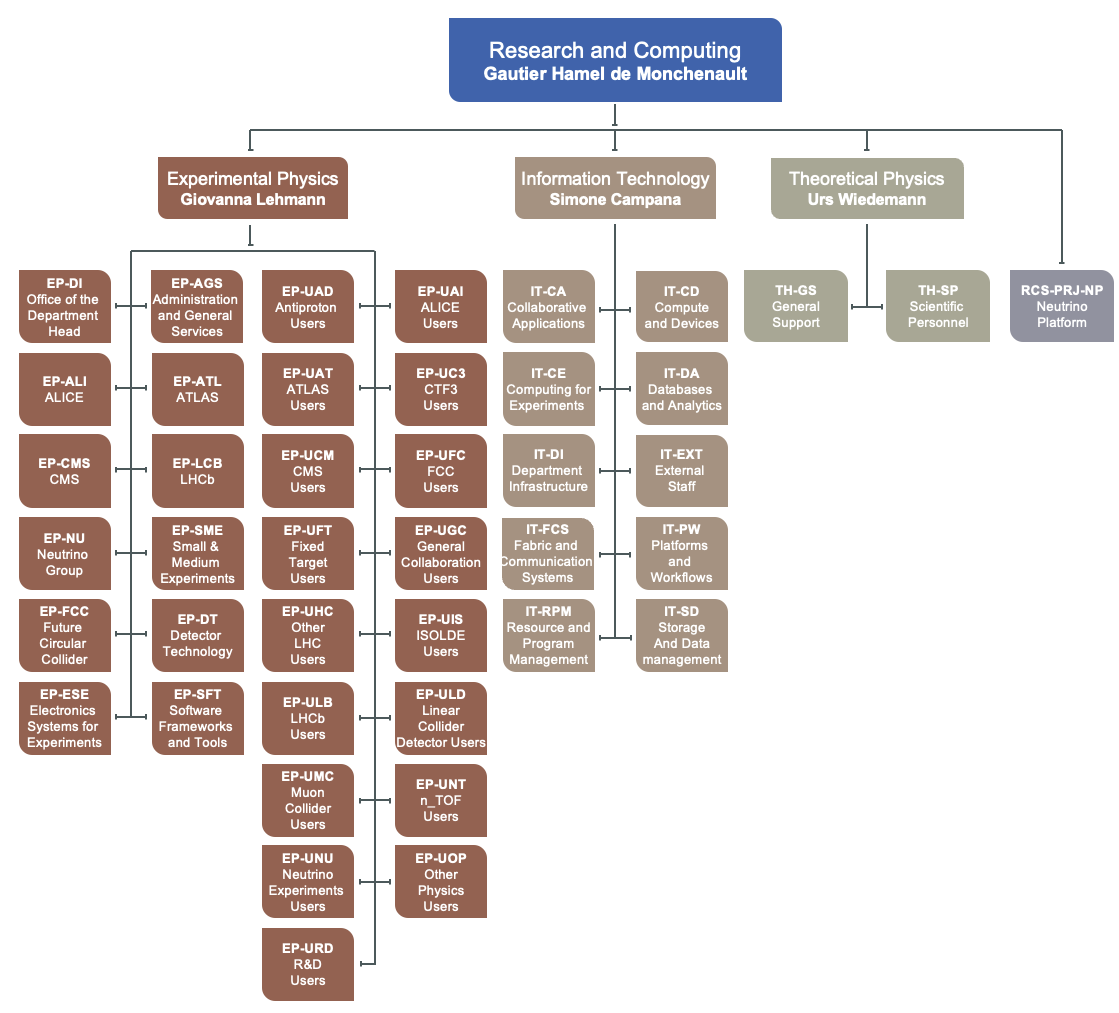
6.2.1 Experimental Physics Department (EP)
EP designs and operates large‑scale particle physics experiments and develops and constructs detectors. In so doing, the Department translates fundamental scientific questions into measurable results. It is one of the largest departments at CERN in terms of the number of staff members and other personnel, including Fellows, Graduates, Associates and Students. In addition, it hosts approximately 12,500 Users, who come to CERN from institutes worldwide to carry out scientific research.
Scope of Activities
EP designs and operates experiments, develops and constructs detectors and acquires and analyses physics data. It conducts research in experimental particle and nuclear physics in close collaboration with, and in support of, the wider scientific community at CERN.
Expertise and Contribution
EP leads and contributes to major international experiments (e.g. at the LHC and beyond), extracting insights from vast datasets to test theoretical models and advance the understanding of fundamental particle physics.
Beyond scientific discovery, EP provides the technological backbone and collaborative platform for the global high-energy physics community and neighbouring scientific fields. It advances detector innovation, supports a worldwide User base and educates and trains the next generation of scientists.
6.2.2 Information Technology Department (IT)
IT supports CERN’s core scientific mission by acting both as a service provider and as a strategic technology partner for the CERN community, delivering state‑of‑the‑art IT services and providing specialised technical expertise to the experiments, accelerators and Users.
Scope of Activities
The Department’s activities broadly cover the following technical domains:
- scientific and distributed computing;
- data storage and data management;
- networks and global connectivity;
- cloud, compute platforms and core services;
- collaborative, administrative and enterprise services;
- cybersecurity and data protection;
- advanced IT research and development.
Expertise and Contribution
A central function of IT is the processing, storage and global distribution of large volumes of scientific data produced by CERN experiments. This includes operating the CERN Data Centre and coordinating CERN’s role as the Tier‑0 site of the Worldwide LHC Computing Grid (WLCG), enabling worldwide access to data for reconstruction, simulation and analysis.
In parallel, the Department prepares the Laboratory for the future, notably in the areas of data management and storage, heterogeneous and parallel computing and scalable architectures. It also fosters innovation and collaboration in scientific computing within the Member States and beyond, including through dedicated training activities such as CERN’s computing schools.
6.2.3 Theoretical Physics Department (TH)
As a centre of excellence in all aspects of theoretical high-energy physics and related areas, TH provides support to the experimental programme of CERN and benefits from its stimulating environment.
Scope of Activities
The Department acts as a high-quality centre of excellence for the international theoretical physics community, allowing physicists to get together, exchange ideas and collaborate. It contributes to education, training and outreach in theoretical physics, both on the CERN site and elsewhere.
Expertise and Contribution
TH aims primarily to foster fundamental research in all fields of direct relevance for high-energy physics, including cosmology, high-energy astrophysics and field and string theory. With the TH Short-term Visitor Programme, the series of TH Institutes and a wide range of workshop activities, working groups and regular meetings, TH facilitates scientific exchange among theorists and between theorists and experimentalists at the CERN Laboratory and elsewhere.
6.3 Stakeholder Relations (SRS)
SR manages CERN’s relationships with its Host States (HS), its Member and Associate Member States (MS and AMS), and non-Member States (NMS), as well as with institutional partners and broader stakeholders, supporting the Organization’s political, institutional and societal engagement.
A key focus for SR for the period 2026–2030 is to build broad support for CERN’s next flagship project, by (i) strengthening the relations with Member and Associate Member States and with the EU, (ii) exploring strategic enlargement, placing emphasis on countries that already have large User communities at CERN, and (iii) efficient communication, outreach and education activities, particularly in the local area. Maintaining excellent relationships with CERN’s Host States (HS), Switzerland and France, as well as overseeing the territorial implementation and engagement of the FCC project, are further key areas of activity for the sector.
Scope of Activities
The Sector is responsible for CERN’s institutional positioning, stakeholder engagement and strategic support. It manages relations with Member and Associate Member States, the Host States, the European Union, and non‑Member States. In parallel, the Sector manages CERN’s external communications, public engagement and educational interfaces.
Organisation and Structure
The Sector is led by the Director for Stakeholder Relations and comprises a small Office of the Director plus two principal operational groups: Stakeholder Engagement (SE) and Education, Communications and Outreach (ECO) (as shown in Figure 4).
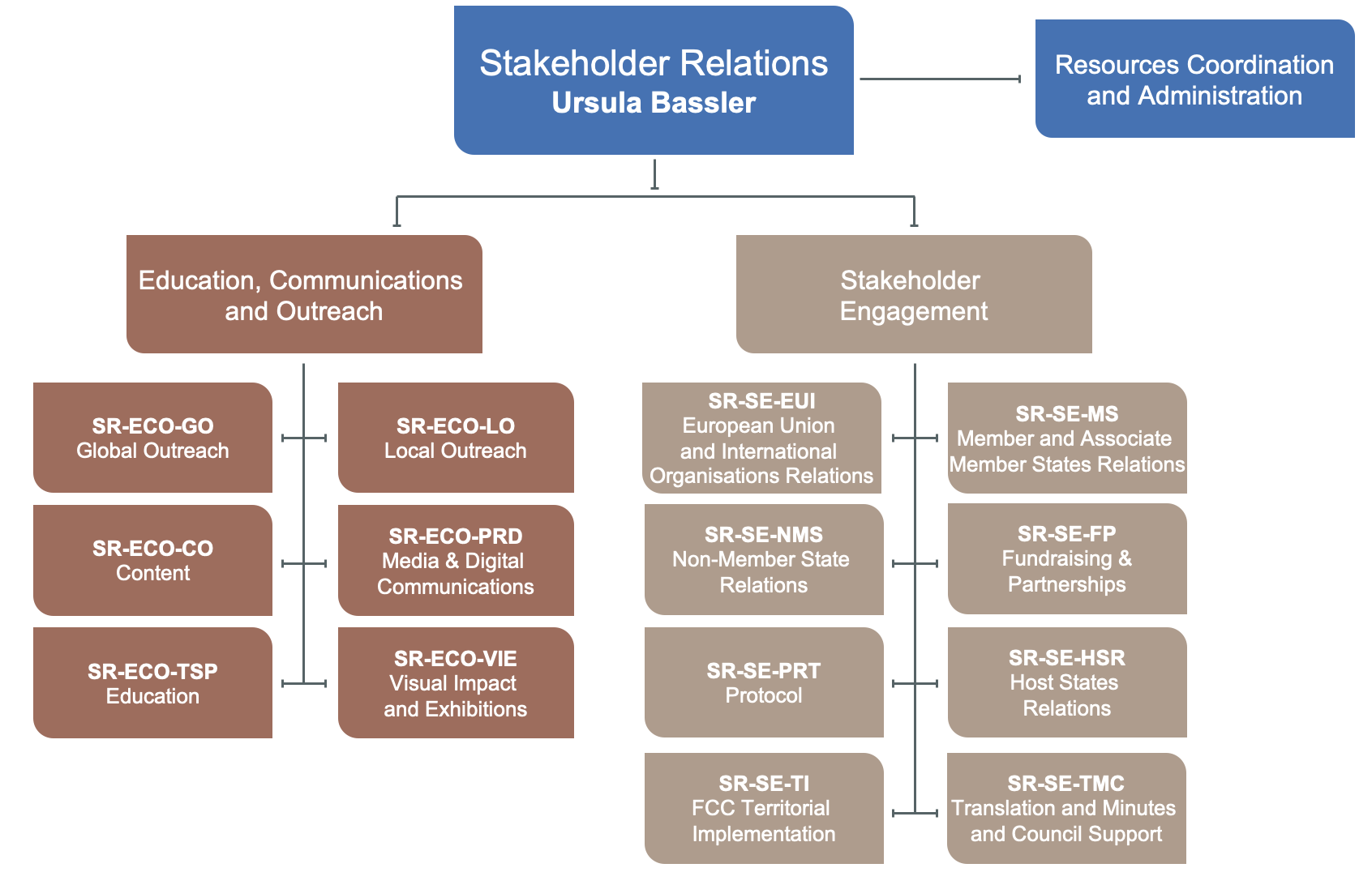
The Office of the Director focuses on resource coordination, administration, planning, HR support, risk management and core Sector functions that support the SE and ECO operational groups in their respective stakeholder engagement and external communication activities.
6.3.1 Stakeholder Engagement Group (SE)
The SE Group maintains and strengthens relationships with key decision-making audiences that directly influence CERN’s support base. CERN’s diplomatic relations with MS, AMS, HS and NMS are therefore at the centre of SE’s activities. The Sector also leads CERN’s fundraising and partnership efforts, provides protocol services for visiting dignitaries, organises the Sessions of the CERN Council and provides translation and minutes support. A dedicated EU Office coordinates CERN’s strategic engagement with the EU authorities and all activities related to EU-funded projects, ensuring close alignment between CERN and the European Commission. A particular emphasis of SE’s work during the mandate will be the territorial implementation and engagement of the FCC project, should the project be approved.
Through these activities, SE drives political, financial and institutional backing for CERN’s scientific programmes and strategic goals.
6.3.2 Education, Communication and Outreach Group (ECO)
The ECO Group oversees CERN’s internal and external communication channels (press, web, social media), content production, brand identity, outreach programmes for schools and teachers, alumni relations, exhibitions and visual impact, and other initiatives such as the “Arts at CERN” programme, that promote CERN’s science and societal mission among the broadest possible audience. The ECO Group works closely with CERN’s “Science Gateway” visitor centre to produce exhibitions and educational activities and plan public events.
A particular responsibility of the ECO Group in the near term is to support and participate in the public debate activities and local engagement efforts in preparation for CERN’s next flagship project.
6.4 Finance and Human Resources (FHR)
FHR ensures that CERN’s financial and human resources are aligned with the Organization’s scientific ambitions and are used as efficiently and effectively as possible.
Scope of Activities
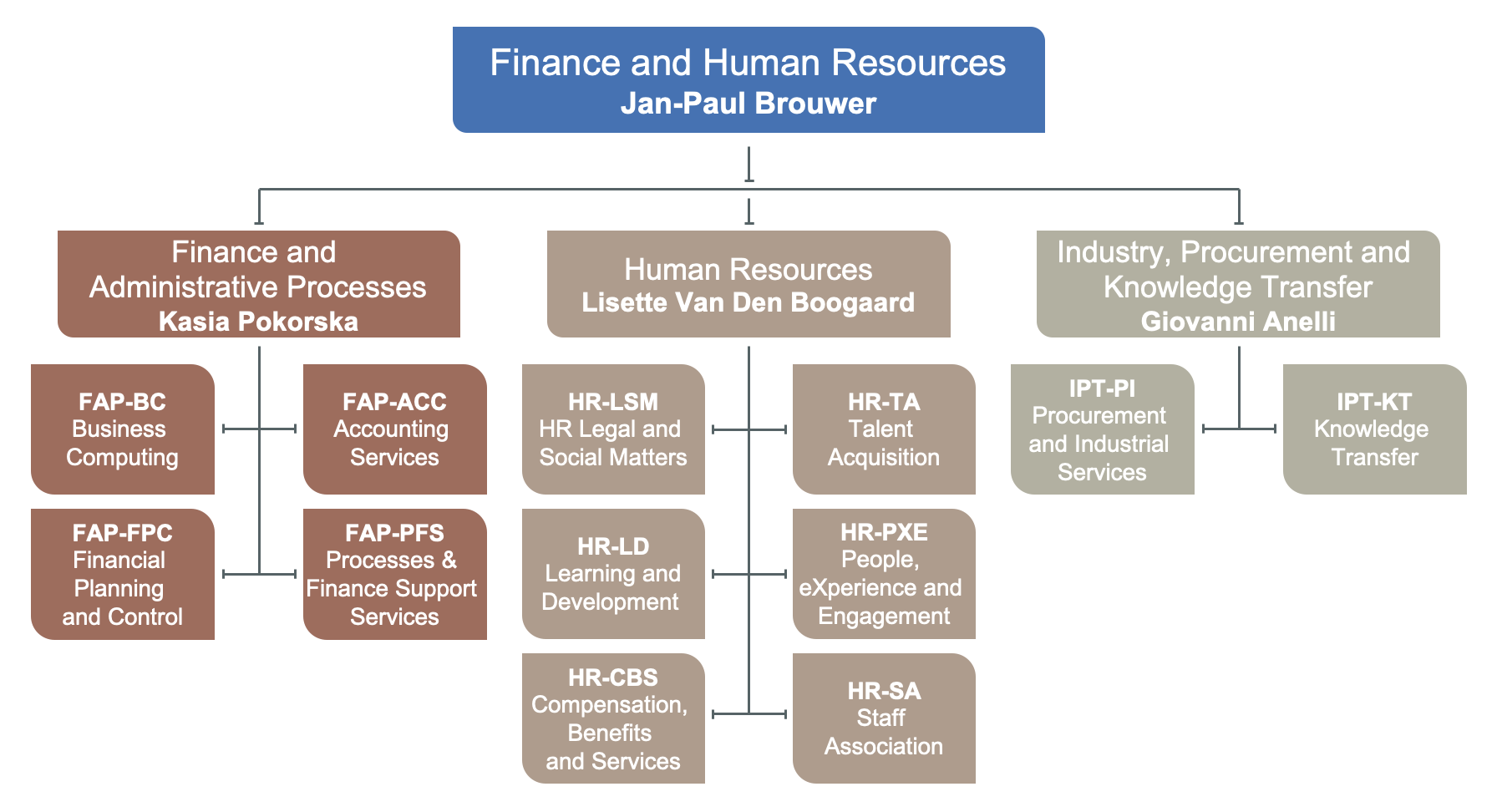
FHR is organised into three departments (as shown in Figure 5). FHR plans, organises and coordinates all of CERN’s financial, administrative, procurement and human resources activities. It develops forward‑looking resource strategies to support the Organization’s future projects. It is also responsible for managing CERN’s intellectual property interests, with the overarching goal of maximising the Organization’s positive impact on society at large.
Expertise and Contribution
The expertise within FHR across CERN’s human resources, finance and accounting, procurement, and knowledge transfer domains ensures that the Sector is able to lead key corporate activities, including workforce planning, support to the Management for the preparation of the Medium-Term Plan, monitoring of budget execution, management of contractual frameworks and the transfer of CERN technologies through licensing and start-up support.
6.4.1 Finance and Administrative Processes Department (FAP)
FAP is responsible for the effective and efficient management of the Organization’s financial resources and commitments while ensuring compliance with CERN’s financial rules and procedures.
Scope of Activities
FAP undertakes CERN’s treasury and accounting operations, prepares the CERN financial statements, reports on third-party accounts, supports financial processes and controls payments relating to invoices, salaries and claims at CERN.
The Department coordinates the short- and long-term financial resource planning of the Organization, provides support to the Management for financial planning decisions and prepares financial documents for the Organization’s governing bodies. It provides internal financial reporting Organization-wide and on a project-oriented basis for the Management. It analyses workforce costs and establishes and maintains guidance pertaining to CERN’s administrative and financial planning procedures.
FAP provides and supports enterprise information systems and related services that underpin CERN’s administrative processes, ensuring coherent data management and process execution across financial, human resources and other business domains.
Expertise and Contribution
FAP provides the following services to the CERN community:
- financial planning and control;
- reporting, analysis, procedures;
- accounting;
- coordination of duty travel;
- treasury operations;
- general insurance management;
- business computing.
6.4.2 Human Resources Department (HR)
HR empowers the Organization’s scientific mission by building, engaging and sustaining a diverse, high-performing workforce.
Scope of Activities
HR is responsible for all of CERN’s human resources activities: the recruitment and sourcing of candidates for all programmes at CERN (from students to staff), identifying and developing learning solutions and helping individuals and managers to create the best possible work environment for themselves and their teams.
HR also provides expertise in financial and social conditions and benefits, from devising policies to attract and retain a quality workforce to providing services to beneficiaries, processing claims, and ensuring compliance with CERN’s legal framework.
Expertise and Contribution
HR provides the following services to the Organization and the wider CERN community:
- personnel administration (including the Cards Service);
- claims and benefits;
- compensation and classification management;
- social services;
- talent acquisition;
- learning and development;
- HR advisory;
- HR legal advice.
6.4.3 Industry, Procurement and Knowledge Transfer Department (IPT)
IPT provides essential support and advice on procurement and knowledge transfer matters and acts as the focal point for all CERN industrial partnerships. It handles the preparation, negotiation and follow-up of around 60 000 orders and hundreds of contracts every year.
Scope of Activities
IPT implements the CERN Procurement Strategy, procuring all supplies and services for the Organization and ensuring that the contractual, technical, delivery, environmental and performance requirements are met (i) at the lowest possible overall cost and with the most advantageous use of CERN’s resources whilst (ii) achieving balanced industrial return and (iii) respecting CERN’s Procurement Rules.
IPT is also responsible for implementing CERN’s Knowledge Transfer (KT) Strategy, aiming to promote CERN as a centre of excellence for technology and innovation and enabling the practical application of CERN technologies through partnerships with industry and other partners. It serves as the focal point for all CERN’s innovation and technology transfer activities, striving to create societal and industrial impact. It liaises with the CERN Member States via the ILO and KT fora.
Expertise and Contribution
IPT provides the following services to the CERN community:
- development, implementation and monitoring of CERN’s Procurement Strategy;
- price enquiries/market surveys/invitations to tender;
- contract drafting and management;
- supplier claims/dispute management;
- business intelligence to anticipate and monitor CERN’s exposure with regard to its supply chain;
- coordination of CERN intellectual property rights (patents, trademarks);
- innovation and technology transfer partnerships;
- support for spin-offs and start-ups using CERN technologies or know-how;
- advice on intellectual property and technology law related matters;
- assessment of CERN’s socio-economic impact on society.
6.5 Site Operations (SO)
SO is responsible for the effective, efficient and sustainable functioning of CERN’s non-scientific and non-accelerator operations, ensuring that the Organization’s infrastructure, services and operational frameworks fully support its scientific mission.
Scope of Activities
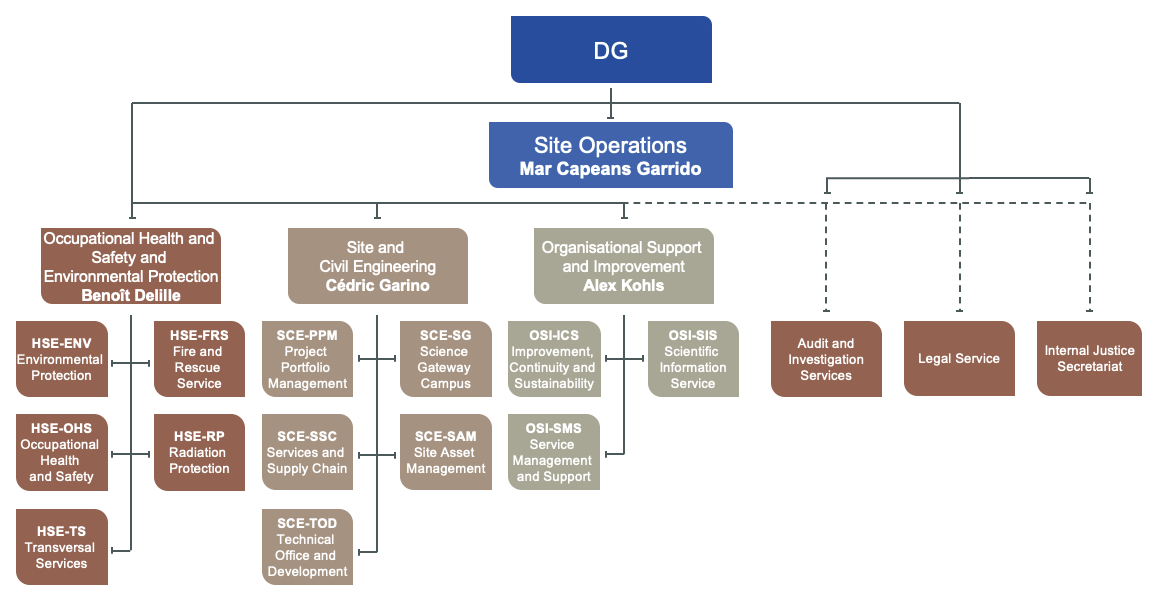
SO is organised into three departments and three units (as shown in Figure 6). SO brings together site development and campus services, safety, health and environmental protection, organisational resilience, sustainability, and scientific information management. It also ensures that CERN’s operations are conducted in compliance with the applicable legal, regulatory and governance frameworks, while promoting continuous improvement and operational excellence across the Organization.
Expertise and Contribution
SO coordinates the planning, development, construction and operation of CERN’s built environment and oversees and ensures the reliable and efficient delivery of essential day-to-day services to the CERN community and its visitors. Through data-driven monitoring, SO aims to continuously improve the community experience and efficiency.
The Sector safeguards people, assets and the natural environment through its management and delivery of the Organization’s occupational health, sustainability, safety, radiation and environmental protection and emergency response capabilities. It strengthens organisational resilience through integrated risk management, crisis preparedness and business continuity management functions. It leads and coordinates CERN’s corporate sustainability agenda.
In addition, SO ensures the effective management, preservation and dissemination of scientific and institutional information, promoting open science, safeguarding CERN’s institutional memory and supporting transparency and accountability.
6.5.1 Organisational Support and Improvement Department (OSI)
OSI is a CERN-wide resource dedicated to improving organisational processes, strengthening resilience and advancing open research practices.
Scope of Activities
OSI leads service management, risk and crisis management and business continuity activities at CERN and coordinates the Organization’s open science, knowledge preservation and sustainability efforts. OSI provides expert guidance on service and process optimisation, resilience, and scientific information and records management. It ensures a culture of continuous improvement and effective practices across CERN.
Expertise and Contribution
As a transversal function, OSI provides and/or coordinates the following services across the Organization:
- continuous improvement and process optimisation;
- risk management;
- crisis preparedness and business continuity management;
- sustainability coordination;
- operation of the CERN library and scientific bookshop;
- scientific information management and open science operations;
- archiving, preservation, and records management;
- service management platform and process consultancy;
- Community Support Centres, helpdesks and service portal.
6.5.2 Site and Civil Engineering Department (SCE)
SCE develops, manages and operates CERN’s physical infrastructure and campus environment. It provides the built environment and operational support necessary for scientific excellence, ensuring that they align with the Organization’s scientific strategy and long-term objectives.
Scope of Activities
SCE manages the full lifecycle of infrastructure and construction projects, from planning and design to execution and maintenance. It ensures that facilities are delivered on time, within budget and according to the highest standards of quality, safety and sustainability. It also ensures the efficient operation of campus services, supporting the daily life of the CERN community while minimising environmental impact.
Expertise and Contribution
SCE provides the following services across the Organization:
- site planning and development;
- cite asset and facility management;
- civil engineering portfolio management;
- housing, catering, mobility and other campus services;
- supply chain management;
- Science Gateway campus operation.
6.5.3 Occupational Health & Safety and Environmental Protection Department (HSE)
HSE serves as CERN’s centre of expertise in safety, occupational health and environmental protection. It is responsible for defining, implementing and monitoring the Organization’s safety framework, ensuring that all CERN activities are conducted in accordance with established rules, regulations and best practices.
Scope of Activities
HSE supports and monitors the implementation of the CERN Safety Policy, the CERN Safety Rules, the CERN Safety Objectives and best practices at all levels. It safeguards the health and safety of personnel, protects the environment and ensures compliance with legal and regulatory requirements. It provides critical corporate safety services, including radiation protection, occupational medicine, environmental monitoring and emergency response. HSE also plays a key role in fostering a strong safety culture across the Organization, integrating safety considerations into all activities, projects and operations.
Expertise and Contribution
HSE provides the following services across the Organization:
- occupational health and safety;
- safety training;
- Medical Service;
- tadiation protection;
- environmental protection;
- Fire and Rescue Service.
6.5.4 Independent functions hosted in the SO Sector
Alongside the three departments, the SO Sector hosts three key independent units that contribute to CERN’s governance, and compliance framework: the Legal Service, the Internal Audit and Investigations Services and the Internal Justice Secretariat. While they retain their functional independence within the Organization by reporting directly to the Director-General, their integration within the SO Sector for the purposes of administrative coordination improves efficiency.
Legal Service (LS)
The LS protects the Organization in all legal aspects and ensures that CERN’s activities and decisions comply with the applicable legal frameworks. The LS provides independent legal advice to the Council and its subordinate bodies, the Director-General and senior management, the Pension Fund and CERN departments and services.
Within the LS, specialist legal advice is available across, inter alia, public international law, institutional and administrative law, international cooperation, financial and commercial transactions, domestic legal matters, intellectual property, donor and grant agreements and dispute resolution.
Internal Audit and Investigation Services (AIS)
Comprised of two separate services, AIS, through its Audit Service, provides independent, objective and risk-based assurance and advisory services to support CERN in achieving its objectives and protecting organisational values. It enhances the effectiveness of CERN’s governance, risk management and internal control processes, and supports the AC and the External Auditors. In parallel, its Investigation Service ensures a robust, consistent and fair approach to the investigation of misconduct across the Organization, strengthening CERN’s accountability and integrity framework.
Internal Justice Secretariat (IJS)
IJS is the registry and support office for CERN’s internal judicial bodies. It provides legal, procedural and administrative support to ensure the effective, independent and consistent functioning of disciplinary and appeals processes. It facilitates access to justice for CERN personnel and contributes to a fair, transparent and accountable internal justice system in accordance with the Organization’s legal framework.
6.6 Office of the Chief Information Officer (OCIO)
The OCIO, led by the Chief Information Officer, defines and coordinates CERN’s digital strategy, ICT policies and the related governance. Building on capacity and expertise already present within departments, OCIO fosters active collaboration across the CERN community to deliver its mandate.
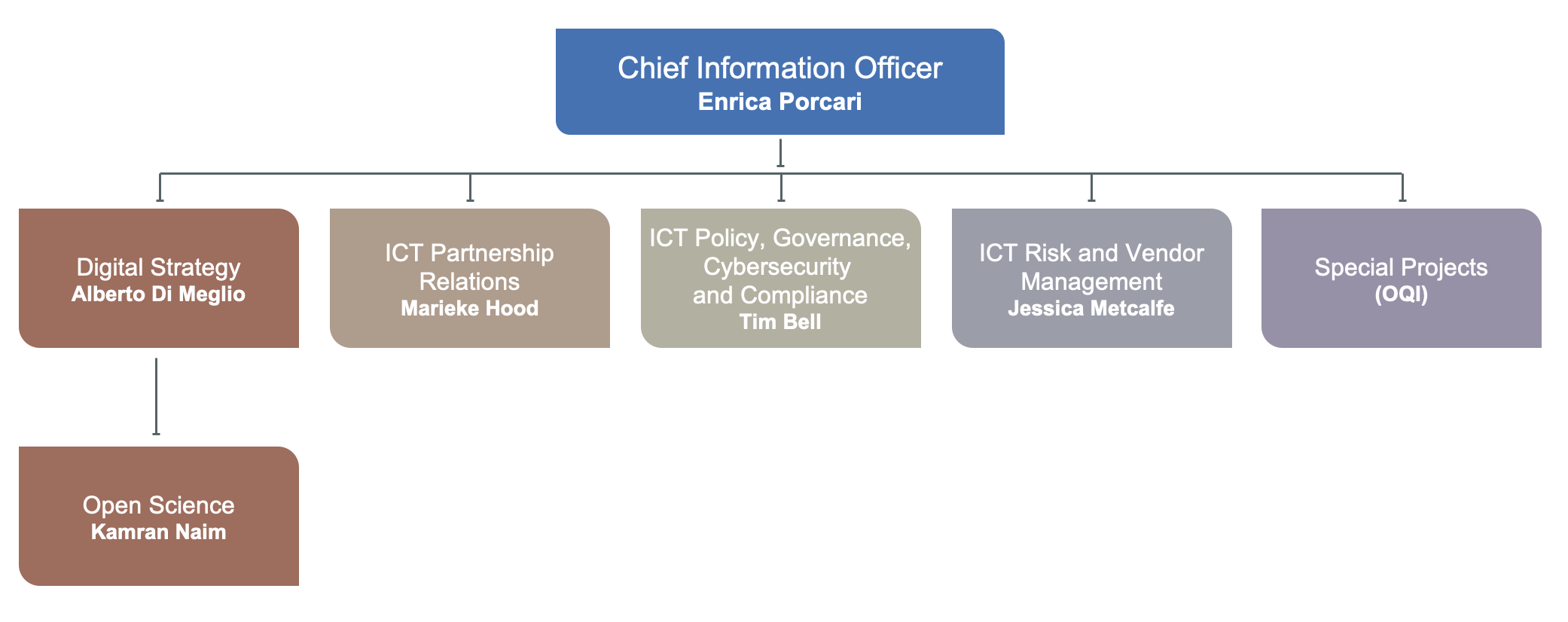
The OCIO encompasses five functions (shown in Figure 7) around digital and ICT themes, including in the domains of cybersecurity and special projects. Some roles are performed by staff embedded in existing departments and contributing part of their time to the OCIO’s work.
Scope of Activities
The Office uses a two-level governance model, which includes a steering level (e.g. the C4 committee) and a technical or programme management level (e.g. the AI Programme Committee). These levels serve as structured channels for coordination and decision making in digital technology matters across the Organization.
Expertise and Contribution
The OCIO’s five core functions cover:
- Digital Strategy (CIO‑DS): development of a CERN-wide digital strategy covering AI, ICT innovation, digital transformation, Open Science strategy and the Open Source Programme Office (OSPO);
- ICT Partnership Relations (CIO‑PR): strategic external partnerships that strengthen CERN’s visibility and influence, advancing CERN’s strategic priorities in digital technologies.
- ICT Policy, Governance, Cybersecurity and Compliance (CIO‑GRC): policy development that meets CERN’s compliance, data privacy, ethical and cybersecurity ambitions;
- ICT Risk and Vendor Management (CIO‑VM): risk, mitigation and supplier governance with respect to technology vendors;
- Special Projects (CIO‑SP): CERN-wide digital initiatives with broad industrial, social and economic impacts.
CERN maintains a formal system of institutional dialogue between the Management and the personnel through the Staff Association.
The Staff Association is independent of the CERN Management and is the statutory representative body of CERN personnel, as recognised by the Staff Rules and Regulations. It serves as the principal collective interlocutor between the personnel and the Organization on matters affecting staff and employment conditions.
The Staff Association participates in a number of official CERN bodies and engages with the Director-General on matters affecting employment and working conditions.
A Standing Concertation Committee (SCC), composed equally of Management and Staff Association representatives, serves as the main forum for discussion on matters concerning the personnel and proposed changes, with both parties working together to try to reach a common position. This framework ensures that staff perspectives are incorporated into CERN’s governance and decision-making processes.
8.1 Core Values
CERN’s core values are integrity, commitment, professionalism, creativity and diversity. Together, these define the shared foundation of behaviour and culture across the Organization. They underpin CERN’s Code of Conduct (described below) and provide a common reference for the standards that individuals are expected to demonstrate in the course of their activities at CERN.
The core values apply to, and are expected from, CERN employed and associated members of the personnel, contractors and all contributors engaged in CERN’s activities:
- Integrity and professionalism ensure that CERN’s scientific mission is pursued with intellectual honesty, ethical behaviour and a strong sense of responsibility, while maintaining high standards in technical, scientific and administrative work.
- Commitment reflects the dedication of CERN’s community to its mission of fundamental research, long‑term projects and international cooperation, often over extended timescales.
- Creativity and diversity are essential drivers of innovation at CERN, enabling new ideas, technologies and approaches to emerge from a multicultural and multidisciplinary environment.
These values not only support scientific discovery but also reinforce CERN’s wider mission to inspire society, train future generations and contribute to the benefit of all. They support trust, credibility and excellence in CERN’s role as a global research laboratory.
8.2 Code of Conduct
Embedded within the Organization’s wider ethics framework, the CERN Code of Conduct sets out the common behaviours expected of everyone who contributes to the Organization, whether as employed or associated members of the personnel, contractors or in any other capacity.
Introduced in 2010, the Code is a concise document, firmly rooted in CERN’s five core values of integrity, commitment, professionalism, creativity and diversity. It applies across CERN’s diverse and international community, but is designed to guide conduct rather than to prescribe specific rules. Consequently, it is not an exhaustive list of “dos and don’ts”, nor does it duplicate legal or regulatory obligations. Instead, it provides a shared ethical compass, helping individuals to understand how to treat others, how they can expect to be treated and how their behaviour reflects on CERN as an institution.
The Code emphasises mutual respect, openness and responsibility, recognising that CERN’s scientific excellence depends not only on technical and intellectual achievement but also on the quality of our working environment. By promoting trust, fairness and accountability, the Code helps to protect CERN’s reputation, supports a respectful workplace and enables the Organization to fulfil its mission of international collaboration in fundamental science.
8.3 A Culture for Success
CERN’s culture for the 2026–2030 period builds directly on its core values. These values provide the foundation for how CERN works, ensuring that its scientific mission is pursued with responsibility, openness and excellence.
In a context of increasingly complex scientific programmes and major strategic priorities, CERN’s success will depend not only on technical capability but also on its ability to operate as a coherent, agile and inclusive organisation. The culture to be fostered therefore emphasises trust, empowerment and clarity of purpose. Personnel at all levels are expected to act within clearly defined strategic priorities, supported by well-focused objectives and a shared understanding of organisational goals.
This approach reflects CERN’s commitment to professionalism and integrity, ensuring that responsibility is matched with accountability and that decisions and actions are guided by transparency and sound judgement. At the same time, it reinforces commitment by aligning the efforts of all sectors and teams behind common priorities, avoiding fragmentation and enabling CERN to act cohesively in delivering its programme.
Operating without silos and strengthening collaboration across the Organization are central to this culture. By promoting openness, mutual respect and inclusiveness, CERN leverages its diversity as a key asset, fostering creativity and enabling innovation across disciplines, cultures and perspectives.
Finally, a strong focus on prioritisation is essential to sustain performance and well-being. Concentrating efforts on the Organization’s highest priorities, while consciously limiting dispersion of activities, supports both efficiency and the long-term engagement of CERN’s personnel.
Through this culture, grounded in its core values, CERN aims to provide an environment in which its community can fully contribute to the success of its scientific mission, while maintaining the trust, credibility and excellence that define the Organization.